How Great Lakes High School's 14km Irrigation Scheme Is Teaching Uganda's Next Generation of Engineers
Most engineering students spend their university years studying in laboratories, working with simulations and waiting for the moment they will be trusted with a real project. At Great Lakes High School in Kanungu, students designed, surveyed and built a functioning 14-kilometre gravity-fed irrigation scheme — before they sat their A level examinations.
There is a persistent gap in African education between the graduate who knows how things work and the graduate who can make things work. The engineer who can solve a differential equation on paper but has never held a theodolite. The agriculturalist who understands irrigation theory but has never laid a pipe. The entrepreneur who has studied business models but has never managed a real enterprise with real money and real consequences.
CHIFCOD's I-LISTENS Innovation Paradigm was designed from the outset to close that gap — to produce graduates who have not merely studied their discipline but practiced it. Nowhere is that philosophy more visibly demonstrated than at Great Lakes High School in Kanungu District, where the school's 14-kilometre student-designed irrigation scheme stands as one of the most remarkable examples of practical engineering education in Africa.
Great Lakes High School — An Overview
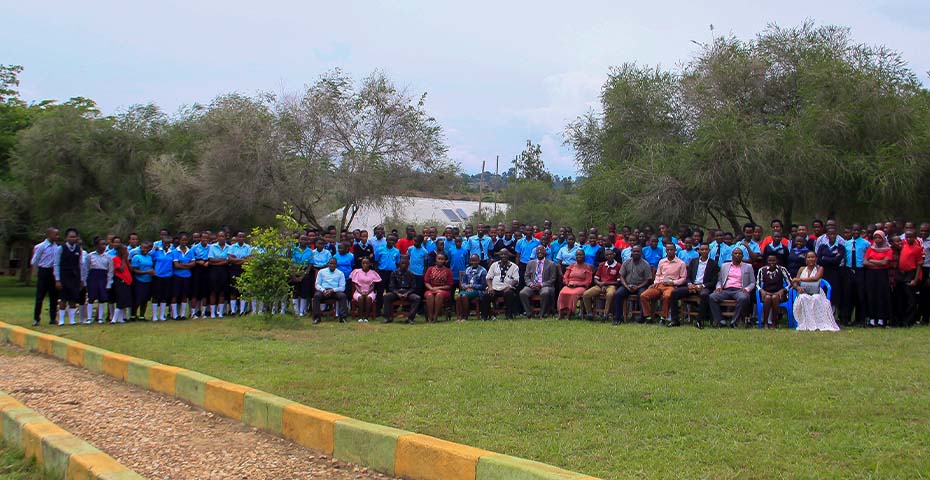
Great Lakes High School is CHIFCOD's flagship secondary and advanced level institution, located in Kanungu District in the highlands of south-western Uganda. Sitting at altitude, surrounded by the agricultural communities that depend on consistent water access for their livelihoods, the school is embedded in a landscape where the problems of engineering are not theoretical exercises — they are daily realities with direct human consequences.
From its founding, Great Lakes was conceived not as a conventional Ugandan O and A level school, but as a living laboratory — a place where academic excellence and practical innovation were not competing values but complementary expressions of the same commitment to transformational education.
The Irrigation Scheme — From Classroom to Community
The 14-kilometre gravity-fed irrigation scheme at Great Lakes is not a teaching model or a demonstration project. It is a functioning infrastructure asset — designed by students working under teacher guidance, surveyed by students learning the practical application of mathematics and physics, constructed through a collaborative community effort and maintained by the student body as part of their ongoing academic responsibilities.
The scheme draws water from a source above the school and distributes it across the school's agricultural enterprise — supporting commercial food production, livestock operations and the school's sustainability goals. The students who designed it had to solve real engineering problems: calculating flow rates across variable terrain, accounting for friction losses across 14 kilometres of pipe, managing the distribution of water pressure across multiple irrigation points and designing a system that would remain functional with limited ongoing maintenance resources.
These are not simplified textbook problems. They are the actual engineering challenges that professional water engineers face daily across Uganda. And the students solved them — not with expensive equipment or university-level resources, but with ingenuity, persistence and the structured problem-solving framework that the I-LISTENS paradigm gives them.
How the Project Was Built — Phase by Phase
Problem Identification & Community Mapping
Students identified the water access challenge facing the school's agricultural enterprise and surrounding community — conducting surveys, mapping existing water sources and documenting current agricultural productivity constraints.
Survey & Engineering Design
Using physics, mathematics and geography, students conducted topographic surveys, calculated hydraulic gradients and designed the gravity-fed distribution system — applying classroom learning to real terrain for the first time.
Resource Mobilisation & Community Partnership
The project required materials, community land access and labour. Students learned to present proposals, negotiate with community members and mobilise resources — invaluable entrepreneurial and leadership skills embedded in a real project.
Construction & Installation
Physical construction of the 14-kilometre scheme — routing pipes across varied terrain, installing distribution points and commissioning the system — carried out by students with teacher oversight and community participation.
Operation, Monitoring & Iteration
Ongoing management of the irrigation system — monitoring output, identifying and resolving technical issues, documenting performance and refining distribution — continues as a live student responsibility year after year.
Beyond Irrigation — The Full Enterprise Model
The irrigation scheme is the most visible expression of Great Lakes' innovation model, but it is part of a broader enterprise ecosystem that gives students practical economic education across multiple disciplines simultaneously.
Commercial Livestock Operations
Students manage commercial livestock operations — cattle, poultry and small animals — that are run as genuine enterprises with financial targets, production records and market relationships. Students do not merely observe these operations: they are responsible for them. They track costs, manage production cycles, respond to market price fluctuations and account for outcomes — building the financial literacy and enterprise management skills that will serve them for the rest of their careers.
The Economic Independence Guarantee
Perhaps the most distinctive outcome of the Great Lakes enterprise model is CHIFCOD's commitment to ensuring that every A level graduate leaves school with personal economic independence. This is not an aspiration — it is a structured program. Students develop and implement personal economic plans across their A level years, with teacher mentorship and peer accountability. By the time they receive their examination results, they already have income-generating activities in operation.
What This Means for Uganda's Future Engineers
Uganda's infrastructure gap is among the most significant constraints on national development. Roads, water systems, energy infrastructure, agricultural irrigation — the country needs tens of thousands of competent, resourceful engineers who can design, build and maintain the systems that development requires. But conventional education produces engineers who have studied theory without practicing it — and the gap between theory and practice costs Uganda dearly.
Great Lakes High School's irrigation scheme represents a fundamentally different answer. It says: give students real problems, real resources and real responsibility — and they will develop the competencies that no curriculum document can manufacture. The student who designed the hydraulic gradient for a 14-kilometre irrigation scheme at 16 years old will approach every subsequent engineering challenge with a confidence and resourcefulness that no university module can create from scratch.
"Commit your work to the Lord, and your plans will be established." The engineers that Uganda needs are not merely technically capable — they are people of purpose, integrity and godly character.
— Proverbs 16:3, foundational to CHIFCOD's innovation philosophy
The Wider Significance — A Model for Africa
The Great Lakes irrigation scheme is one data point in a much larger story. Across CHIFCOD's five campuses, the I-LISTENS Innovation Paradigm is producing evidence that practical, enterprise-based education works — in highland Uganda, in forest-edge communities, in savanna flatlands. The model does not require expensive technology or international donor funding. It requires a commitment to putting real problems in front of students and trusting them to solve them.
As the Jungle Professor Rendezvous Africa Center opens in Kampala in 2026, that model will become available to educators, school leaders and policy-makers across the continent. The story of Great Lakes High School's 14-kilometre irrigation scheme is not a Ugandan story — it is an African proof of concept. And Africa's next generation of engineers is waiting to build on it.
Engineering is not something you study until the real work begins. At Great Lakes High School, the real work is the study. And fourteen kilometres of flowing water is the proof.